


Why are Acupuncture needles sometimes placed nowhere near the pain?
One of the most common questions people have about acupuncture is:
“If my shoulder hurts, why would a needle be placed in my hand?”
Or:
“If my knee is the problem, why are needles being placed in my foot?”
It is a very reasonable question.
The answer is that acupuncture doesn’t necessarily work by treating pain only at the place where it is felt.
Acupuncture points — including points well away from the painful area — can stimulate sensory nerves and send signals into the nervous system. These signals may influence the way the spinal cord and brain process pain, as well as muscle activity and the body’s systems for regulating stress and relaxation.
This is one reason acupuncture can look very different from other forms of treatment.
Pain isn’t simply a message coming from one spot
When the back, knee, shoulder or neck hurts, it is natural to think of pain as a direct message from that particular area:
“Something hurts here, so the treatment needs to happen here.”
But pain is more complicated than that.
Pain is produced by the nervous system in response to information coming from the body. The brain is constantly receiving and interpreting signals from muscles, joints, nerves and other tissues.
It also takes into account many other factors, including:
-
previous injuries
-
inflammation
-
stress
-
sleep
-
movement
-
attention
-
emotions
-
previous experiences of pain
-
whether the nervous system feels safe or threatened
This does not mean that pain is “all in your head”.
Pain is real.
It means that the nervous system has the ability to turn pain signals up or down.
And this is one of the reasons acupuncture can have effects beyond the area where a needle is placed.
Why use Acupuncture points away from the painful area?
The nervous system is a connected network.
When an acupuncture needle stimulates sensory nerves in the skin and underlying tissues, those nerves send information towards the spinal cord and brain.
The nervous system then processes that information and responds to it.
This can influence systems involved in:
-
pain processing
-
muscle tone
-
circulation
-
inflammation
-
stress responses
-
autonomic nervous-system activity
-
the body’s natural pain-relieving mechanisms
This means a needle does not necessarily have to be placed directly into a painful area to influence how that pain is experienced.
These are often called distal acupuncture points — points located away from the area of pain.
Research into acupuncture for chronic musculoskeletal pain has found that both local and distant acupuncture points can produce pain-relieving effects, although the size and duration of these effects can vary between conditions and studies.
So if someone has shoulder pain and receives an acupuncture needle in the hand or forearm, there is a physiological rationale for doing so. The aim is not necessarily to treat the hand itself; the point is being used as a way of providing sensory input to the nervous system.
The “Pain Gate”: One way of understanding Acupuncture
One useful way of explaining acupuncture’s effects is through something called the Gate Control Theory of Pain.
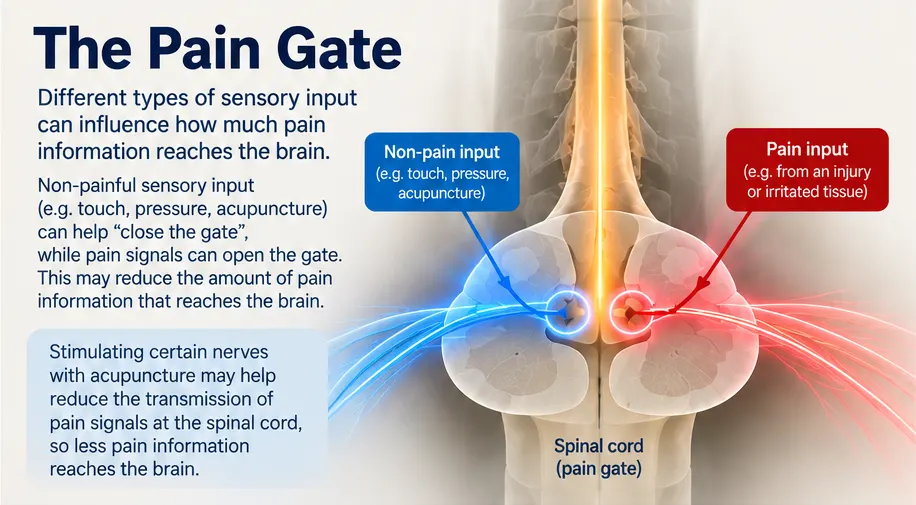
Imagine that the spinal cord contains a series of gates that influence how much pain-related information is transmitted towards the brain.
When the nervous system receives a lot of threatening or painful information, the “volume” of that information can effectively be increased.
But other types of sensory input — including touch, pressure and stimulation of particular nerve fibres — can interact with the transmission of pain signals.
This is one reason that rubbing an area after bumping it can sometimes make it feel better.
The injury hasn’t disappeared.
Instead, the sensory information reaching the nervous system has changed.
Acupuncture provides another form of sensory stimulation. Research suggests that acupuncture can influence pain processing at the spinal cord and brain and can activate several of the body’s own pain-modulating systems.
The pain-gate theory isn’t the complete explanation for acupuncture, but it provides a useful way of understanding why stimulating one area of the body can influence pain perceived somewhere else.
The brain has its own pain-relieving system
The body has sophisticated built-in mechanisms for controlling pain.
The brain can send signals downwards towards the spinal cord that can reduce the transmission and perception of pain.
These are often referred to as descending pain-modulation pathways.
Acupuncture appears capable of influencing these pathways and can also affect endogenous pain-relieving chemicals, including the body’s own opioid systems.
In simple terms, acupuncture may not simply be trying to “block” a pain signal.
It may also help activate the body’s own systems for turning pain down.
This is particularly interesting when pain has become persistent or chronic, because long-lasting pain can involve changes in the sensitivity and behaviour of the nervous system.
The sympathetic and parasympathetic nervous systems.
Another important part of understanding acupuncture is the autonomic nervous system.
This is the part of the nervous system that automatically regulates many functions, including heart rate, breathing, digestion, blood pressure, sweating, circulation, alertness and relaxation.
Two major branches are the sympathetic and parasympathetic nervous systems.
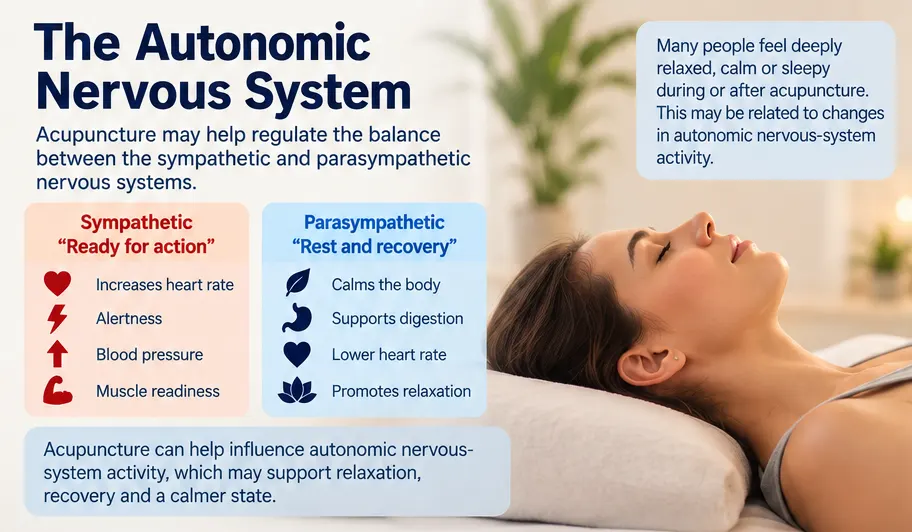
The sympathetic nervous system: “Ready for action”.
The sympathetic nervous system helps prepare the body to respond to challenges.
It can increase:
-
heart rate
-
alertness
-
blood pressure
-
muscle readiness
This response is extremely useful when action is required.
The problem isn’t having a sympathetic nervous system — it is essential to normal life.
However, prolonged stress, pain or threat can be associated with increased autonomic arousal and difficulty returning to a calmer physiological state.
The parasympathetic nervous system: “Rest and recovery”
The parasympathetic nervous system is associated with rest, digestion and recovery.
When the body moves towards a calmer state, heart rate and arousal can decrease and resources can be directed towards functions such as digestion and recovery.
This may help explain why some people feel deeply relaxed, calm, heavy or sleepy during or after acupuncture.
Research suggests that acupuncture can influence autonomic nervous-system activity, although the precise effects vary according to the type of acupuncture, the individual and the circumstances.
Rather than thinking of acupuncture as simply “switching off the sympathetic nervous system”, it is more accurate to think of it as potentially helping to regulate autonomic activity.
Why does this matter for pain?
Pain and the body’s stress response can influence one another.
When the nervous system is highly alert, pain can become more noticeable and the body can become more protective.
And when someone is experiencing persistent pain, the nervous system can become more vigilant.
This can contribute to a cycle:
Pain → tension → increased arousal → increased sensitivity → more pain
Acupuncture may help influence parts of this cycle by providing sensory input to the nervous system and affecting pain-processing and autonomic pathways.
This doesn’t mean that pain is caused by stress.
A person can have a very real physical injury, inflammation or tissue problem while also having a nervous system that is influencing how strongly the pain is experienced.
Both things can be true at the same time.
Why not simply needle the painful area?
Sometimes local Acupuncture is appropriate.
But there are also good reasons for using distal points.
A painful area may be:
-
highly sensitive
-
inflamed
-
irritated
-
difficult to access
-
surrounded by protective muscle tension
-
uncomfortable to needle repeatedly
Using a distal point provides another way of stimulating the nervous system without necessarily adding stimulation directly to an already painful area.
In some treatments, both local and distal points may be used.
In others, treatment may focus primarily on distal points.
The choice depends on the type of pain, its location, how long it has been present and how an individual responds to treatment.
Acupuncture vs placebo: what does the research show?
This is one of the most important questions in acupuncture research.
If people feel better after acupuncture, how do we know that the improvement isn’t simply because they expect acupuncture to work?
This is where placebo-controlled research becomes important.
Acupuncture presents a particular challenge for researchers because creating a convincing placebo is much harder than it is with a conventional tablet.
Researchers have therefore developed specially designed non-penetrating placebo needles. These can look and feel similar to genuine acupuncture needles, while avoiding actual penetration of the skin.
This allows researchers to compare penetrating acupuncture with a credible control treatment.
And some of the results are particularly interesting.
A landmark double-blind Acupuncture study
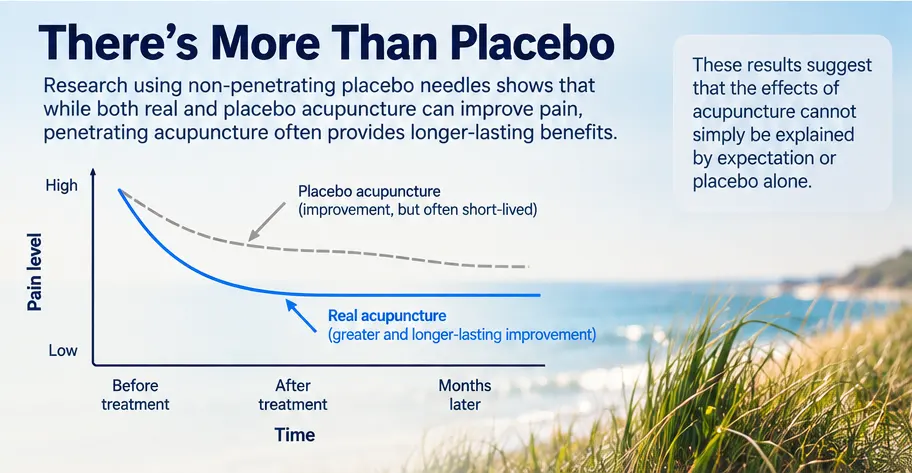
Research led by Professor Judith Schlaeger used specially designed Acupuncture needles that allowed both the patient and practitioner to remain unaware of whether the needle was actually penetrating the skin or providing the non-penetrating control treatment.
Both groups experienced improvements in pain.
However, the group receiving penetrating acupuncture experienced a longer-lasting reduction in pain, with benefits continuing for months after treatment.
This is significant because it provides evidence of an effect that cannot simply be explained by participants knowing they had received genuine acupuncture.
The study is also particularly notable because genuine double-blinding has historically been extremely difficult to achieve in acupuncture research.
In other words, the results provide evidence that the effects of Acupuncture cannot simply be dismissed as nothing more than placebo or expectation.
That doesn’t mean that placebo effects are irrelevant.
Expectation, the therapeutic relationship, relaxation and the context in which a treatment is delivered can all influence how people experience pain. These factors can be present alongside genuine physiological effects.
The important point is that modern acupuncture research suggests that there is more happening than placebo alone.
We are still learning exactly how Acupuncture works
It is important to be honest about what science does and doesn’t know.
There isn’t one single mechanism called “the acupuncture mechanism”.
Instead, the evidence points towards acupuncture being a complex intervention involving several interacting systems.
These may include:
Peripheral nerves → spinal cord → brain → pain-modulation systems → autonomic nervous system → changes in pain processing
There can also be local effects around the area being needled.
Researchers have identified mechanisms involving the nervous system, endogenous opioids and other neurochemical processes, spinal pain modulation, brain activity and autonomic regulation.
So when an acupuncture point is selected on the hand, foot, lower leg or another area away from the pain, it isn’t necessarily an arbitrary choice.
The point can be used to provide a specific type of sensory stimulation to the nervous system.
The simplest way to think about distal Acupuncture
If you remember only one thing, remember this:
Acupuncture doesn’t necessarily need to treat pain where you feel it.
The painful area is one part of a much larger system.
By stimulating sensory nerves at carefully selected points, acupuncture can provide information to the nervous system that may influence:
-
how pain is processed
-
how muscles respond
-
how the body’s stress systems are regulated
-
how the brain’s natural pain-relieving systems function
That’s why sometimes a needle in the hand is being used to help with a shoulder problem.
And sometimes a needle in the foot is being used to help with a knee problem.
The goal isn’t simply to put a needle where it hurts.
The goal is to use the body’s nervous system as part of the treatment.